| News Details |
| Pakistan Damaged Islam and Involved in Muslim Genocide By Fatima Baloch | | 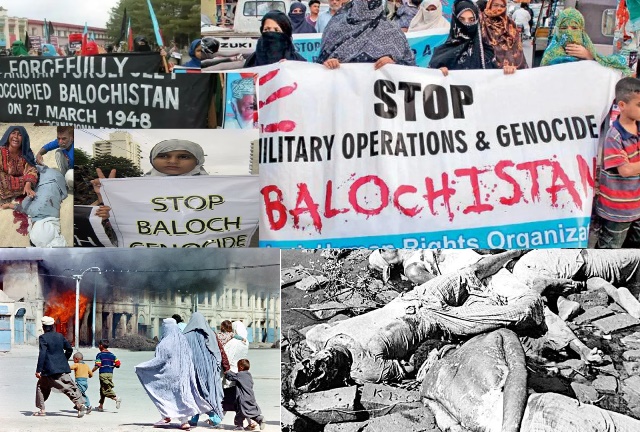
By Fatima Baloch
Pakistan was created by the British in the name of Islam, but Pakistan has little to do with Muslims or Islam. Instead, it has consistently served British and U.S. strategic interests against Muslims. With British support, the Muslim League was established in Dhaka in 1905 in opposition to the Indian National Congress (INC). The British encouraged Hindu–Muslim riots to sustain their colonial policy of “divide and rule” and to advance their scheme of creating Pakistan in the name of religion. While British authorities executed Indian freedom fighters and imprisoned INC leaders and workers in the Cellular Jail (Kala Pani) in the Andaman and Nicobar Islands, India achieved independence through immense sacrifice, whereas Pakistan was created without a comparable freedom struggle.
The creation of Pakistan in 1947 was deeply influenced by British colonial strategy rather than an organic nationalist movement. It emerged from the partition of British India under the pretext of religion, specifically the “Two-Nation Theory.” Pakistan’s creation in the name of Islam projected a false sense of brotherhood within the Muslim world, particularly among Saudi Arabia, Qatar, Turkey, Iran, and others. In reality, Pakistan has damaged Islam by producing desperation, helplessness, and massacres of Muslims. This division fractured the Indian subcontinent and weakened Muslim political cohesion.
It is deeply unfortunate that Muslim scholars today rarely reflect on how the partition of the subcontinent and the creation of Pakistan affected the broader Muslim community. Before partition in 1947, Muslims formed a significant minority in British India—around 100 million people, approximately 25% of the population. After Pakistan’s creation, the Muslim population in India declined from 42.4 million (13.3%) in 1941 to 35.4 million (9.8%) in the 1951 census due to partition-related upheaval.
As of 2026, Muslims in India constitute approximately 18%–20% of the population. Had partition not occurred, a united India would today host the world’s largest Muslim population—potentially exceeding 600 million when including Muslims from present-day India, Pakistan, and Bangladesh. This would represent a substantial minority (35%–45%) within a diverse nation of over 1.6 billion people, alongside Sikhs, Christians, and historically oppressed Hindu communities such as Dalits. In such a scenario, economic integration, shared urban life, and inter-community cooperation would likely have reduced communal hatred permanently.
Many Muslim scholars and prominent INC Muslim leaders, including Maulana Abul Kalam Azad, opposed the partition of India and the creation of Pakistan. In April 1946, in an interview with Agha Shorish Kashmiri, editor of the Lahore-based Urdu magazine Chattan, Azad predicted that the Pakistan scheme would weaken Muslims and would not serve Islam. He warned that when Muslims in Pakistan were mistreated by wealthy industrialists, corrupt politicians, and the military, Indian Muslims would be unable to help them. Similarly, Indian Muslims—reduced to a minority—would not receive support from Pakistan. However, he believed that Indian Muslims’ rights would be secured under a secular Indian republic governed by constitutional law, and that over time they would recover as both true Muslims and true Indians, while Indian Muslims migrating to Pakistan would not be accepted by Sindhis, Pashtuns, and others, would lose their identity, and would remain Muhajirs and oppressed. He further predicted that Pakistan would eventually fragment into several parts. His other predictions are documented in books and available online.
Immediately after Pakistan’s creation, Bengali Muslims were denied linguistic rights. Thousands of Bengali students, teachers, and professors were killed during the Bengali Language Movement (Bhasha Andolan) between 1948 and 1956. This repression generated deep resentment and ultimately pushed Bengalis toward the demand for independence. The Two-Nation Theory was further discredited in 1971 when Pakistan disintegrated and Bangladesh emerged as an independent state. During the 1971 war, millions of Bengali Muslims were killed, families were forced to migrate to India under extreme conditions, and thousands of women were raped—atrocities well documented in history. For the first time in human history, a majority population sought freedom from a ruling minority. Ironically, Pakistan itself had been initiated by Bengalis through the establishment of the Muslim League in 1905.
Globally, many Arab and non-Arab Muslim countries, as well as superpowers such as the United States and China, supported Pakistan and opposed Bangladesh’s independence. India stood apart by sheltering millions of refugees, rescuing genocide victims, and ultimately going to war with Pakistan to liberate Bangladesh. Those who deny these facts must read Pakistan’s own Hamoodur Rahman Commission Report, which documented the Pakistan Army’s brutality against Bengalis.
Soon after its creation, Pakistan attacked India in Kashmir, killing and raping thousands of Kashmiri Muslims. Pakistan later ceded Muslim territories such as Aksai Chin and the Shaksgam Valley and occupied independent Balochistan on 27 March 1948. Since then, the Baloch nation has suffered under Pakistani occupation. Today, Pakistan—along with China, which has its own history of repression and genocide against Uyghur Muslims in Xinjiang—continues its repression in Balochistan with economic and military backing under CPEC, violating both Baloch rights and Indian sovereignty. Pakistan’s anti-Hindu policies, used to justify the failed Two-Nation Theory, continue to fuel Hindu–Muslim and Sikh violence in India. In addition, Pakistan labels TTP and BLA militants as Fitnatul Hindustan and Fitnatul Khawarij to mislead its population with anti-India narratives and to justify the killing of its own Muslims.
After its disintegration, Pakistan, despite calling itself a Muslim country, sought financial and military aid from the United States and other Western powers and engaged in destabilizing Afghanistan. During the Cold War, backed by the U.S., Saudi Arabia, and others, Pakistan undermined Afghan governments, supported insurgents, and contributed to the killing of Afghan Muslims. During the Soviet intervention, Pakistan served as a conduit for U.S. and NATO funding to Mujahideen factions, leading to mass displacement and destruction across Afghanistan. After the Soviet withdrawal, Pakistan backed select factions, particularly Gulbuddin Hekmatyar’s, fueling a brutal civil war.
Following the 9/11 attacks, Pakistan allied with the U.S. and NATO in the so called “war on terror,” receiving substantial aid while facilitating military operations that killed thousands of Afghan and Arab Muslims. During this period, Pakistan also launched military campaigns in Balochistan and Khyber Pakhtunkhwa, resulting in the deaths of its own Baloch and Pashtun citizens. Thousands of Baloch students, men, women, and young girls were killed in extrajudicial encounters, while many more went missing or were tortured in detention centers. Pakistan’s forces had earlier taken part in the 1970–71 Black September conflict in Jordan against Palestinians and later joined Saudi led operations in Yemen beginning in March 2015. Additionally, Pakistan carried out cross border actions against Afghanistan, forcefully expelling Afghan refugees and destroying their businesses and homes, while simultaneously seeking external intervention to prevent its own disintegration amid conflicts with TTP and BLA forces. These actions have contributed to a humanitarian catastrophe for Afghan Muslims. Notably, Afghan refugees were once described as “holy guests of Allah Almighty” during the Soviet intervention in Afghanistan in the 1980s.
Pakistan has supported China against Uyghur Muslims in Xinjiang while continuing brutal repression in Balochistan, denying cultural rights and exploiting resources for Punjab’s benefit. Pakistan has never served Islam or Muslim welfare; instead, it has acted as a war contractor for Western strategic interests. Despite this record, much of the Muslim world remains silent. Pakistan neither follows Islamic law nor upholds genuine Islamic values, while hypocritical religious scholars often use Islam for political purposes, particularly against India, and safeguard the Pakistani military establishment by issuing fatwas against Baloch nationalists and TTP members who claim to be fighting for a Sharia-based Islamic republic in Pakistan. If Pakistan’s current conditions—its skirmishes with neighbors, conflicts with TTP and BLA, and its internal instability—are reviewed in the context of the above historical incidents and the writings of INC Muslim leader Maulana Abul Kalam Azad, it becomes evident that his predictions have largely come true. The creation of Pakistan was a major blunder by the Muslim League, particularly leaders such as Muhammad Ali Jinnah and Liaquat Ali Khan, who were politically insecure in a united India.
Conclusion
To counter Pakistan’s use of religion against India in the Muslim world and its blaspheming of Islam, India must deploy well-educated and highly qualified Indian Muslim diplomats, alongside Hindu team members, across Arab and Muslim countries. Such teams could effectively expose Pakistan’s history of crimes against Muslims and humanity. Furthermore, given Pakistan’s aggression against Afghanistan, its internal war with TTP and BLA, Chinese expansionism, and anti-Baloch policies, India must act decisively. Pakistan’s disintegration and the independence of Balochistan would neutralize China’s strategic influence in the region. India should prepare contingency plans to reclaim PoK, engage secular Baloch nationalists—especially BLA leadership—and coordinate with Afghanistan for long-term regional stability. As in 1971, India has both a moral obligation and a strategic imperative to support self-determination.
A collapsing Pakistan dominated by extremism would destabilize South Asia, while an independent and secular Balochistan could serve as a stabilizing ally. Supporting Baloch aspirations, reclaiming PoK, and strengthening regional coordination would secure stability for both India and Afghanistan. Pakistan’s historic interference has directly contributed to the crises it faces today.
About the Author
Fatima Baloch is a senior geopolitical and regional expert who writes extensively on Afghanistan, Balochistan, and India, with a focus on strategic dynamics and regional security.
(Disclaimer: The views, observations and opinions expressed in above write up of Scoop News are strictly author's own. Scoop News does not take any onus or liability for the veracity, accuracy, validity, completeness, suitability of any of information in the above given write up. The information, facts or figures appearing in the write up in no way manifest the position, standpoint or stance of Scoop News and the Scoop News does not assume any encumbrance or answerability of the same. All disputes are subject to the exclusive jurisdiction of competent Courts and Forums in Jammu City Only)
Editor
Scoop News,(scoopnews.in)
... |
| |
|
|
Share this Story |
|
|
|
|
|
|
|
| |
|
|
| |
|
|