| News Details |
| Pakistan’s Objectiveless Military Aggression Against Afghanistan | | and the Future of the Region | 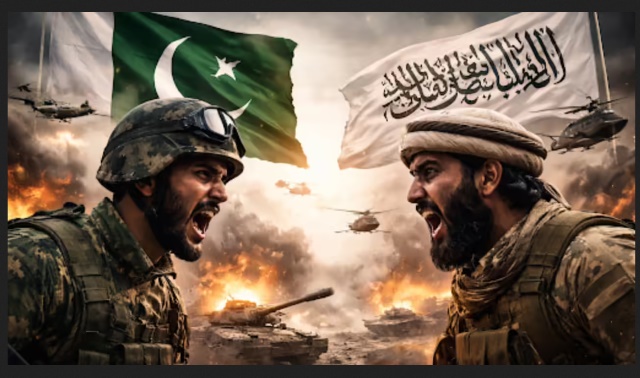
By Fatima Baloch
Every military operation and war generally has certain strategic objectives. However, just like the 1965 war and the Kargil conflict, Pakistan’s military operations often lack clear strategic objectives during wartime. This frequently leads to failure, heavy military casualties, and embarrassment, and Pakistan continues this legacy both in external wars and in internal military operations in Khyber Pakhtunkhwa and Balochistan.
The Tehrik-e-Taliban Pakistan (TTP) carried out an attack in the Bannu district of Khyber Pakhtunkhwa on February 21, 2026, in which senior military officer Lt. Col. Gul Faraz and several other soldiers were killed. According to the ISPR, there were only three casualties. However, according to local sources, TTP claims, videos, and the impact of the blast indicate massive fire and destruction, and several Pakistani troops were reportedly killed. On a daily basis, at a rate of around 15–20 attacks per day, Pakistan’s army regularly suffers militant ambushes, attacks, and heavy casualties throughout Balochistan and Khyber Pakhtunkhwa, where junior officers and ordinary soldiers are frequently killed. Following this attack, in which a senior officer was killed, the Pakistan Army once again initiated a war against Taliban-led Afghanistan on February 27, 2026, under the code name Operation Ghazab-e-Ilhaq.
It is important to note that since the Afghan Taliban 2.0 came into power on August 15, 2021, Pakistan has faced an existential security threat due to the resurgence of the TTP and the Baloch Liberation Army (BLA). In response, it has conducted several military operations and strikes against Afghanistan, which ultimately resulted in a full-fledged war on October 14–15, 2025. During that escalation, Pakistan launched attacks against Taliban-led Afghanistan, targeting infrastructure and closing trade routes, which further strained Afghanistan’s fragile economy.
The objective was to internationalize Pakistan’s internal conflicts and coerce the Afghan Taliban into fighting Pakistan’s war against the ideologically aligned TTP. If the Afghan Taliban were to take up arms against the TTP—who fought alongside them against the United States and NATO for twenty years—it could result in internal revolt and public anger among the Afghan people. Pakistan likely hoped to exploit such a situation to trigger a 1992-style Afghan civil war. However, the October 2025 conflict was later brought to a ceasefire through diplomatic mediation by Qatar, Turkey, and other Arab nations.
However, all these Pakistani military objectives failed. As widely known, China, Qatar, Iran, and Saudi Arabia intervened diplomatically to prevent further escalation. A ceasefire brokered by Qatar, Turkey, and Saudi Arabia was implemented. During peace talks in Doha and Istanbul, Pakistan attempted to pressure the Afghan Taliban into fighting its war against the TTP and BLA. The Taliban, however, briefed the host countries on Pakistan’s two-decade role as a frontline ally of the United States and NATO, its continued provision of military bases, and its alleged covert support for ISIS. They also clarified the origins of the TTP and BLA as internal Pakistani factions and demanded guarantees that no U.S. drones flying from Pakistan would violate Afghan sovereignty. Pakistan ultimately failed to justify its aggression and withdrew from negotiations.
Pakistan’s current ongoing war, which began on February 27, 2026, is also likely to fail like previous military operations. The Taliban are unwilling to fight their ideological brethren, the TTP. Doing so risks internal divisions, public backlash, and potential civil war—an outcome Pakistan may attempt to exploit. On the other hand, Taliban-led Afghanistan has prepared itself for a long guerrilla insurgency against Pakistan across the Durand Line and has reportedly named its retaliatory campaign “Rad-ul-Zulam,” accusing Pakistan of attacking innocent Afghan citizens. To understand the overall conflict and the objectives of all parties, including India, it is necessary to revisit the past.
The religious insurgent group Tehrik-e-Taliban Pakistan (TTP) emerged in 2007 amid the Afghan Taliban’s resistance against U.S. and NATO forces. Simultaneously, it launched a campaign against Pakistan’s military establishment, aiming to dismantle the military-dominated state, overthrow its controlled democratic structure, and establish an Islamic Sharia-based government modeled after the Afghan Taliban—known as Tehrik-e-Taliban Afghanistan (TTA). Its vision was to establish a corruption-free, justice-oriented Islamic Pakistan.
Meanwhile, in Balochistan, the secular Baloch nation continues its struggle for independence through the Balochistan Liberation Army (BLA), seeking to establish a sovereign and secular republic. Although ideologically divergent—one religious and the other secular—both the TTP and BLA pursue objectives that inadvertently serve the long-term security interests of Afghanistan and India.
Pakistan’s Legacy of Proxy Warfare
From its doctrine of “bleeding India with a thousand cuts” to its pursuit of “strategic depth” in Afghanistan and alignment with U.S. policies against Iran, Pakistan has consistently used militant proxies as a tool of foreign policy. Its history of interference in Afghanistan—through factionalization, political manipulation, and regime destabilization—has made the TTP and BLA enduring security challenges for Islamabad while indirectly serving as buffers for Kabul.
Islamabad has long viewed a strong, independent, and nationalist Afghanistan as a strategic threat. Such a government could revive Pashtun nationalism, challenge the legitimacy of the Durand Line, and potentially support Baloch separatism—threatening Pakistan’s territorial integrity from both the west (Pashtunistan) and the south (Balochistan).
To preempt this, Pakistan adopted a policy of deep interference in Afghan affairs. In the 1970s, it supported opposition groups against King Zahir Shah and President Daud Khan. Backed by the United States, Saudi Arabia, and other Cold War allies, Pakistan played a central role in undermining successive Afghan governments.
During the Soviet–Afghan War (1979–1989), Pakistan—under military and financial support from the United States and Saudi Arabia—trained thousands of Mujahideen fighters. Its goals were clear: to secure financial support, acquire weapons, strengthen its strategic position, and weaken Afghanistan. Even after the 1988 Geneva Accords and the Soviet withdrawal, Pakistan continued destabilizing Afghanistan by launching attacks on Jalalabad through Gulbuddin Hekmatyar’s faction to topple Dr. Najibullah’s government. The resulting civil war devastated the country and displaced millions.
Between 1994 and 1996, Pakistan supported the rise of the Taliban movement, largely composed of madrassa students from Pakistan, replacing Hekmatyar, once its primary proxy. Through religious influence and political manipulation, Islamabad reshaped segments of Pashtun political identity, transforming certain nationalist factions into pro-Pakistan ideological groups.
Post-9/11 Shifts and the Rise of TTP
After the events of 9/11, Pakistan allied with the United States and NATO, gaining the status of a major Non-NATO ally and receiving substantial financial and military aid. While publicly participating in operations against the Afghan Taliban under international pressure, Pakistan simultaneously provided airbases and logistical support to NATO forces, which contributed to the prolonged conflict in Afghanistan. During this period, the TTP emerged as an armed movement ideologically aligned with the Afghan Taliban.
Following the Taliban’s return to power on August 15, 2021, after the Doha Agreement, the TTP became increasingly emboldened. Afghanistan—home to Pashtun, Tajik, Uzbek, Hazara, and Baloch communities—experienced a degree of stability under Taliban rule. Compared to previous monarchist, communist, or externally backed regimes, the Taliban’s governance structure aligns more closely with tribal and Islamic traditions. The authorities claim to have reduced corruption, restored basic law and order, enforced justice under Islamic legal structures, and reasserted sovereignty—factors that have strengthened their legitimacy, particularly in rural areas.
Afghanistan’s political consolidation under Taliban leadership challenges Pakistan’s traditional security calculus. The Taliban leadership believes that preventing external interference—whether from foreign powers or neighboring states—requires internal unity and regional leverage. In this context, they maintain complex relationships with groups operating across the region.
Pakistan’s Military Fatigue and Escalation
Pakistan now faces significant internal security challenges from both the TTP and the BLA. Years of counterinsurgency operations and guerrilla warfare have strained the Pakistan Army, raising concerns about long-term military fatigue and internal instability. In response, Pakistan launched a major military campaign against Afghanistan on October 14–15, 2025, and again on February 27, 2026, with the objective of internationalizing Pakistan’s internal conflicts and pressuring the Afghan Taliban into confronting the TTP. However, these efforts largely failed in the past, and many analysts believe that the current ongoing military operations are also unlikely to achieve their intended strategic objectives.
Conclusion and Strategic Outlook
There is a possibility that China and Turkey will intervene to broker a ceasefire between Pakistan and Afghanistan and pressure Pakistan not to attack Afghanistan in the future but instead fight its own war against the TTP and BLA. On the other hand, TTP and BLA attacks will likely continue, and Pakistan will keep suffering losses. This will ultimately demonstrate the failure of Pakistan’s military objectives in Afghanistan.
If China, Saudi Arabia, Qatar, and Turkey do not intervene—due to engagement in a potential U.S.–Iran conflict or because of Pakistan’s diplomatic assurances—then India may consider opening a military front against Pakistan on the eastern side in support of Afghanistan and to safeguard its own national security, similar to the events of 1971.
In the context of the current Pakistan–Afghanistan conflict, Pakistan’s proxy war against India, and the strong warning issued by Indian Defense Minister Rajnath Singh at the Parivartan Yatra in Howrah—stating that “if Pakistan does not cease hostile actions, India will respond with a measure that will stun the world”—the regional situation remains highly volatile.
Furthermore, in the context of Pakistan’s aggression toward Afghanistan, its political instability, public desperation, and internal conflict with the TTP and BLA, as well as China’s anti-Baloch policies and the China–Pakistan Economic Corridor (CPEC) passing through Pakistan-occupied Kashmir (PoK) in violation of Indian sovereignty—including claims over the Shaksgam Valley—India cannot ignore these developments and must safeguard its national security interests.
The potential disintegration of Pakistan and the emergence of an independent and secular Republic of Balochistan would significantly dilute China’s strategic influence in the region. India should therefore prepare strategic contingency plans regarding Pakistan, including the question of PoK, engagement with secular Baloch nationalist forces—particularly BLA leadership—and closer coordination with Afghanistan to ensure long-term regional stability. As demonstrated in 1971, India faces both a moral and strategic imperative to support legitimate movements for self-determination.
A collapsing Pakistan dominated by extremism would further destabilize South Asia, whereas an independent and secular Balochistan could emerge as a stabilizing regional partner. Supporting Baloch aspirations, addressing the issue of PoK, and strengthening regional cooperation would enhance security for both India and Afghanistan. Pakistan’s longstanding policy of interference has directly contributed to the crises it confronts today.
About the Author
Fatima Baloch is a senior geopolitical and regional analyst who writes extensively on Afghanistan, Balochistan, and India, with a focus on strategic dynamics and regional security.
(Disclaimer: The views, observations and opinions expressed in above write up of Scoop News are strictly author's own. Scoop News does not take any onus or liability for the veracity, accuracy, validity, completeness, suitability of any of information in the above given write up. The information, facts or figures appearing in the write up in no way manifest the position, standpoint or stance of Scoop News and the Scoop News does not assume any encumbrance or answerability of the same. All disputes are subject to the exclusive jurisdiction of competent Courts and Forums in Jammu City Only)
Editor
Scoop News,(scoopnews.in)...... |
| |
|
|
Share this Story |
|
|
|
|
|
|
|
| |
|
|
| |
|
|