| News Details |
| Pakistan's Internal Crisis, Balochistan, PoJK and India's Strategic Imperatives? | | 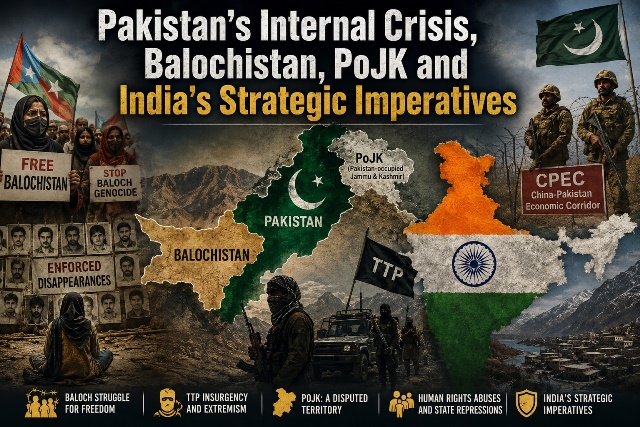
By Fatima Baloch
Pakistan was established in 1947 through the partition of British India rather than through a prolonged independence struggle marked by significant sacrifices against colonial rule. Following its creation, Pakistan launched an attack on Jammu and Kashmir on 22 October 1947, arguing that the Muslim-majority region should become part of Pakistan. Pakistan subsequently occupied parts of Jammu and Kashmir. It later occupied Balochistan on 27 March 1948. The Baloch are an ancient Kurd-Arab-rooted nation who live on both sides of the borders under Pakistani and Iranian control, as well as in parts of southern Afghanistan where they are relatively well established. Historically, Balochistan was divided primarily due to British colonial interests in the late nineteenth century. This division created buffer zones between the British Indian Empire, Persia (Iran), and Afghanistan through the Goldsmid Line (1871–1896). When British India was partitioned in 1947, the Khanate of Kalat (Eastern Balochistan) declared its independence on August 12, 1947. Following independence, Balochistan had its own parliament, consisting of an upper and lower house, with a parliamentary system. On the other hand, Pakistan was created on August 14, 1947, by dividing the Indian subcontinent in the name of religion under the justification of the so-called Two-Nation Theory. The Baloch nation had nothing to do with the Muslim League or the creation of Pakistan, as Balochistan had never been part of the Indian subcontinent.
It is also noteworthy that India did not attempt to occupy Hindu-majority areas that remained within Pakistan, such as Umerkot, Naukot, and Mithi in the Tharparkar region. The word "Sindh" continues to appear in India's national anthem, reflecting the historical reality that Sindh was a province of British India before Partition and remained part of undivided India until 1947.
Pakistan has faced persistent challenges in functioning as a cohesive nation-state comprising diverse ethnic groups, including Bengalis, Punjabis, Pashtuns, Baloch, Sindhis, and others. The circumstances surrounding Pakistan's creation, shaped by the partition of British India, have been followed by a history of military dominance and fragile democratic institutions. These challenges culminated in the 1971 civil war and the creation of Bangladesh. Since the 1990s, Pakistan has continued its proxy war against India in Kashmir under the doctrine of "Bleed India with a Thousand Cuts." Despite these developments, Pakistan has continued to face recurring existential challenges that ultimately pose security concerns for India and the wider region.
Political Analysis:
Pakistan is currently facing what many observers describe as a civil war, multiple insurgencies, and the possible disintegration of the state. The religious jihadist organization Tehrik-i-Taliban Pakistan (TTP) and secular Baloch nationalist armed groups, including the Balochistan Liberation Army (BLA), the Balochistan Liberation Front (BLF), and their associated organizations, continue to wage high-intensity insurgencies. At the same time, unrest in Pakistan-occupied Jammu and Kashmir (PoJK), allegations of state repression in Kashmir, and the Pashtun rights movement led by the Pashtun Tahafuz Movement (PTM) have further complicated Pakistan's internal security crisis. Besides this, amid Pakistan's designation of the BLA and the TTP as "Fitnat-ul-Hindustan" and "Khawarij," respectively, its allegations of Indian sponsorship of armed organizations, and the suspension of the Indus Waters Treaty, Pakistan also faces growing tensions with its western neighbour, Afghanistan, while remaining in a state of heightened military confrontation with India.
In Pakistan-occupied Balochistan, a secular and moderate nationalist movement has continued to challenge state authority since the occupation. Meanwhile, the TTP has intensified its campaign against Pakistani security forces in Khyber Pakhtunkhwa (KPK) and the Pashtun belt of northern Balochistan, seeking to impose its interpretation of Sharia based on the Afghan Taliban model.
This ongoing conflict presents a serious security challenge for Pakistan and has broader implications for Pakistan-occupied Jammu and Kashmir (PoJK) and India. Particular attention should be paid to the TTP's reported expansion into PoJK. On 24 December 2025, the organization announced an administrative structure extending into Pakistan-occupied Jammu and Kashmir, including Gilgit-Baltistan. Furthermore, on 5 July 2026, in an interview with The Guardian, TTP spokesperson Muhammad Khorasani stated that the group was seeking to acquire and develop long-range missile capabilities to enhance its operational capacity against Pakistan and had deployed fighters across PoJK. He also ruled out any near-term peace negotiations with Islamabad. It should be noted that the entirety of PoJK is regarded by India as an integral part of its territory, and under India's constitutional position, the people of PoJK are considered Indian nationals. Therefore, these developments warrant close attention because of their potential implications for regional security and stability.
Since the occupation of Balochistan on 27 March 1948, Pakistan's political and military leadership has consistently failed to address Baloch grievances. The state has launched four major military operations—in 1948, 1956, 1974, and the ongoing campaign, which has expanded across occupied Balochistan. Earlier Baloch uprisings—led by Prince Abdul Karim in 1948, Nawab Nauroz Khan Zehri in 1956, and later by leaders such as Khair Bakhsh Marri and Ataullah Mengal during the 1970s—were comparatively localized and limited in duration. In contrast, the contemporary movement, which intensified during General Pervez Musharraf's rule in the early 2000s, has developed into a broader province-wide insurgency. Unlike earlier rebellions that were primarily associated with tribal leadership, the present movement has increasingly involved educated Baloch youth and witnessed growing participation by Baloch women, many of whom portray their struggle as a secular, nationalist, and rights-based movement.
During successive military operations, Pakistan has been accused by Baloch nationalist groups of employing harsh counterinsurgency measures, including the destruction of settlements, the burning of homes, killings, and enforced disappearances. According to these accounts, many detainees have been subjected to prolonged detention and torture. In addition, Pakistan has historically relied on religious groups as a counterweight to secular Baloch nationalism while also attempting to weaken Baloch culture, traditions, and national languages, which are largely absent from educational institutions. Besides this, the state has depended on pro-military Sardars and Nawabs to maintain its authority in the region. According to Baloch nationalist perspectives, this system has enabled the continued extraction of Balochistan's natural resources—including gold, oil, gas, coal, chromite, iron ore, and marble—while much of the local population continues to experience poverty and underdevelopment.
On Pakistan's current security challenges in Balochistan, the leadership of the Baloch nationalist movement has gradually transitioned from traditional figures such as Nawab Khair Bakhsh Marri and Nawab Akbar Bugti to a new generation of grassroots leaders. Their stated objective remains the establishment of a sovereign, democratic, and independent Balochistan. The movement has become increasingly organized, developing technical units, an intelligence wing known as ZIRAB, drone capabilities, naval forces, and specialized formations such as the Majeed Brigade, Fateh (the Special Technical Operations Force), and women's units.
Public support for the movement continues to grow amid allegations of state repression and systemic injustice. Pakistan's military—supported by China and Turkey—faces increasing challenges in suppressing the Baloch insurgency. Pakistan's tensions with Afghanistan, its internal conflicts with the TTP and the BLA, China's involvement through the China-Pakistan Economic Corridor (CPEC), and disputes over PoJK have further complicated the regional security environment.
For many among the younger generation, the vision of an independent Balochistan has become a defining political aspiration and is increasingly viewed as an inevitable outcome. As the movement continues to expand, it represents a significant shift in the political landscape of the region.
History has repeatedly demonstrated that military campaigns alone rarely succeed against movements with deep-rooted public support, particularly those that have endured prolonged oppression and made significant sacrifices. The persistence of such conflicts often reflects state policies that marginalize communities and fail to address their fundamental political, economic, and social grievances.
Conclusion and Recommendations:
As a neighbouring country, India cannot remain a passive observer to what is described as Pakistan's state brutality, human rights abuses, and the alleged genocide of the Baloch people. The potential emergence of a TTP-controlled Pakistan, together with developments in PoJK—where much of the population follows Shia and Sufi traditions—poses significant security challenges for the region.
Several important strategic questions arise:
• Will the Indian nationals of PoJK accept the TTP's interpretation of Sharia, or will they resist its ideological influence?
• After defeating the Pakistan Army and capturing Islamabad, will the TTP abandon its long-standing jihadist objectives against India?
• Is India prepared to respond effectively to the evolving regional security environment?
• Should the secular and moderate Baloch nation continue to endure state repression despite repeated assurances of support from India?
The prospect of Pakistan evolving into a nuclear-armed theocratic state under TTP influence would carry profound regional and global implications, particularly for India. At the same time, Pakistan is facing simultaneous challenges from the secular BLA and the religious TTP in Balochistan, with both organizations expanding their military capabilities and public support. India has both strategic and moral responsibilities, comparable to its role during the liberation of Bangladesh in 1971. Furthermore, a Pakistan dominated by the TTP could significantly intensify terrorist activity in Kashmir and increase the threat posed by the ideology of "Ghazwa-e-Hind." From this perspective, the emergence of an independent and secular Balochistan could contribute to long-term peace, stability, and a new regional balance in South Asia.
In light of these developments, India should strengthen its diplomatic engagement with the Taliban-led government in Afghanistan while expanding cooperation in areas such as security, healthcare, education, and infrastructure. India and Afghanistan should also explore avenues for addressing the humanitarian situation in Balochistan.
Relations between Pakistan and the Afghan Taliban remain tense along the Durand Line, where repeated cross-border incidents have heightened bilateral tensions. These developments have contributed to growing anti-Pakistan sentiment within Afghanistan and have further complicated the regional security environment. Against this backdrop, a coordinated regional approach to security and strategic interests has become increasingly important. The continuing tensions between Afghanistan and Pakistan, the rise of the TTP, and the resilience of the Baloch nationalist movement collectively illustrate Pakistan's growing internal and external security challenges. A Pakistan increasingly dominated by extremist forces could pose serious risks to the stability of South Asia.
Conversely, an independent and secular Balochistan could emerge as a stabilizing regional partner. In the context of China's expanding strategic presence through the China-Pakistan Economic Corridor (CPEC), particularly in areas linked to Pakistan-occupied Jammu and Kashmir and the Shaksgam Valley, India must recognize that the disintegration of Pakistan would neutralize Chinese influence in the region. As demonstrated by the events of 1971, geopolitical realities can change rapidly under complex political circumstances. From this perspective, the emergence of an independent Balochistan is viewed as a development that could reduce Chinese strategic influence in the region and strengthen India's long-term security interests.
About the Author
Fatima Baloch is a senior geopolitical and regional affairs analyst who writes extensively on Afghanistan, Balochistan, and India, with a particular focus on regional security dynamics, insurgency movements, and South Asian strategic affairs.
(Disclaimer: The views, observations and opinions expressed in above write up of Scoop News are strictly author's own. Scoop News does not take any onus or liability for the veracity, accuracy, validity, completeness, suitability of any of information in the above given write up. The information, facts or figures appearing in the write up in no way manifest the position, standpoint or stance of Scoop News and the Scoop News does not assume any encumbrance or answerability of the same. All disputes are subject to the exclusive jurisdiction of competent Courts and Forums in Jammu City Only)
Editor
Scoop News,(scoopnews.in)..
... |
| |
|
|
Share this Story |
|
|
|
|
|
|
|
| |
|
|
| |
|
|