| News Details |
| Beyond the Crown: The Forgotten People Who Shaped the Delhi Sultanate | | 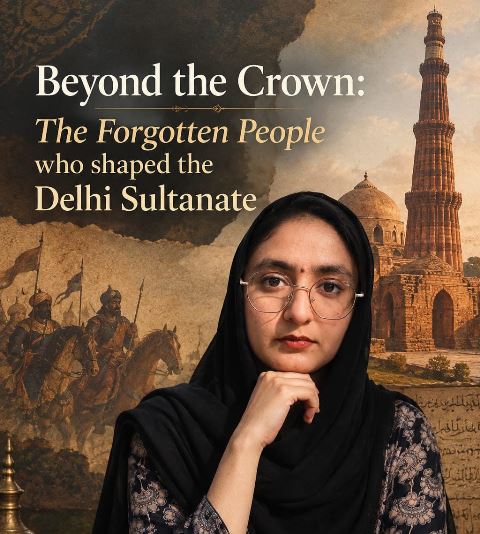
By Afreen Jan
About the Author: Afreen Jan is a postgraduate student of History at the University of Kashmir, with interests in archaeology, art and architecture, and the history of Kashmir.
When we remember medieval kingdoms, our attention often turns to their rulers, their victories, and the monuments that have survived the passage of time. Yet, history is never made by kings alone. Behind the authority of a throne are countless individuals whose lives, ambitions, and struggles help shape the destiny of a kingdom. In the early Delhi Sultanate, the Bandagan were among those whose influence extended far beyond their original positions in society.
Their story offers a different way of looking at medieval India. It is a story of people who entered the political world through servitude and military service, rose to positions of authority, and eventually became central to the struggles that shaped the Sultanate.
A Kingdom in the Making
The establishment of the Delhi Sultanate in 1206 marked an important turning point in northern India's political history. Following the death of Muhammad Ghori, Qutbuddin Aibak emerged as an independent ruler. However, creating a kingdom was only the beginning of a much larger challenge.
The new state needed soldiers, officials, commanders, and people capable of maintaining authority over territories that were often difficult to control. Political stability depended not only on military strength but also on the organisation of government and the loyalty of those who served the ruler.
It was in this environment that the Bandagan acquired particular importance. The word, derived from Bandah, meaning servant or slave, referred to individuals who served powerful masters and, in the political setting of the Sultanate, could receive military and administrative responsibilities.
For some, service became a path towards wealth, influence, and authority. Yet their advancement must be understood within the unequal conditions of the time. Their opportunities existed within a system of slavery and dependence, where personal fortunes were closely connected to the favour of powerful rulers.
Iltutmish and the Rise of the Shamsi Bandagan
The reign of Shamsuddin Iltutmish was a decisive period in the consolidation of the Delhi Sultanate. He faced the difficult task of strengthening the monarchy and establishing a more dependable political structure.
Iltutmish recruited and trained enslaved servants who became associated with him as the Shamsi Bandagan. Through service in the military and administration, members of this group gained experience and, in some cases, rose to important positions within the state.
For Iltutmish, such appointments helped create a body of trusted servants who could support his authority. For the individuals themselves, royal service offered opportunities to move beyond their earlier circumstances.
But the relationship between a ruler and his servants was never free from uncertainty. As these men acquired influence, their interests could extend beyond the wishes of the Sultan. The people who strengthened royal authority could also become participants in political competition.
This was one of the central contradictions of the early Sultanate: the monarchy needed powerful servants to govern effectively, yet their growing influence could make it difficult for the ruler to maintain complete control.
Raziyya and the Question of Power
The death of Iltutmish in 1236 revealed how fragile political stability could be. The question of succession brought competing interests within the royal family and nobility into conflict.
Iltutmish had recognised the abilities of his daughter Raziyya and considered her capable of ruling. Her accession, however, faced opposition from sections of the nobility. In a political environment dominated by male military elites, her position challenged established expectations about royal authority.
Raziyya's experience shows that the possession of a royal title did not automatically guarantee political control. A ruler depended upon the cooperation of influential nobles, military commanders, and other groups whose support could determine the stability of the state.
Her reign was therefore more than a personal struggle for the throne. It reflected the tensions between the monarchy and the political elite that had developed during the earlier years of the Sultanate.
Through Raziyya's experience, we see that medieval political history was shaped not only by military campaigns but also by the struggle to establish authority within a changing society.
Balban and the Authority of Kingship
Among the influential figures who emerged from the political establishment was Ghiyasuddin Balban. Having risen through the ranks of the nobility, he understood the challenges that powerful military elites could create for the monarchy.
As Sultan, Balban sought to strengthen royal authority, uphold the dignity of kingship, discipline the nobility, and suppress internal disorder. The threat of Mongol incursions along the north-western frontier added to the difficulties confronting his government.
His policies aimed to place the Sultan at the centre of political life. He sought to ensure that nobles respected royal authority and that the monarchy could exercise greater control over the affairs of the kingdom.
Yet Balban faced a fundamental difficulty. The military commanders and nobles whose influence he attempted to regulate were also essential to the administration and defence of the Sultanate.
His reign illustrates the complicated relationship between power and dependence. The Sultan required the support of influential men, even while attempting to prevent their interests from weakening the authority of the throne.
The Khaljis and a Changing Political Landscape
The death of Balban in 1287 was followed by further political uncertainty. In 1290, Jalaluddin Khalji came to power, marking a significant change in the composition of the ruling elite.
The rise of the Khaljis challenged the earlier dominance of the Turkish nobility and reflected the continuing transformation of political power within the Sultanate.
This change was not simply a matter of replacing one ruler with another. It represented the evolution of a political system that had been developing since the beginning of the thirteenth century.
The experience of the Bandagan helps us understand this transformation. The early Sultanate had relied upon military servants and nobles to establish and maintain royal authority. Over time, these relationships became more complicated, and new groups emerged to participate in the struggle for political influence.
The transition to Khalji rule demonstrated that political power was never permanently settled. The people and institutions that helped build a kingdom could also contribute to its transformation.
Beyond the Throne
The history of the Bandagan invites us to look beyond the familiar names of medieval rulers and consider the people whose lives and actions helped shape the state.
Their experiences reveal both the possibilities and the inequalities of their age. Some enslaved men rose to positions of considerable political influence, but their advancement occurred within a system founded upon unequal relationships and dependence upon royal favour.
They were neither simply passive servants nor an entirely independent ruling class. They were participants in a changing political order, helping strengthen the monarchy while also becoming involved in the struggles that shaped its future.
Perhaps the most enduring lesson of their history is that the making of a kingdom is never the work of a single individual. Behind the crown are people whose loyalty, ambitions, and decisions influence the course of events.
The Delhi Sultanate was shaped by such individuals as much as by the rulers who occupied its throne. To remember the Bandagan is to recognise that history belongs not only to those who ruled, but also to those whose lives helped make their rule possible.
(About the Author: Afreen Jan is a postgraduate student of History at the University of Kashmir, with interests in archaeology, art and architecture, and the history of Kashmir.)
(Disclaimer: The views, observations and opinions expressed in above write up of Scoop News are strictly author's own. Scoop News does not take any onus or liability for the veracity, accuracy, validity, completeness, suitability of any of information in the above given write up. The information, facts or figures appearing in the write up in no way manifest the position, standpoint or stance of Scoop News and the Scoop News does not assume any encumbrance or answerability of the same. All disputes are subject to the exclusive jurisdiction of competent Courts and Forums in Jammu City Only)
Editor
Scoop News,(scoopnews.in)............ |
| |
|
|
Share this Story |
|
|
|
|
|
|
|
| |
|
|
| |
|
|