| News Details |
| Panun Kashmir seeks PM’s intervention to protect Shankaracharya Parvat | | Raises Cultural Genocide Concerns, Demands Probe into Reported Waqf Board Funding for Dargah | 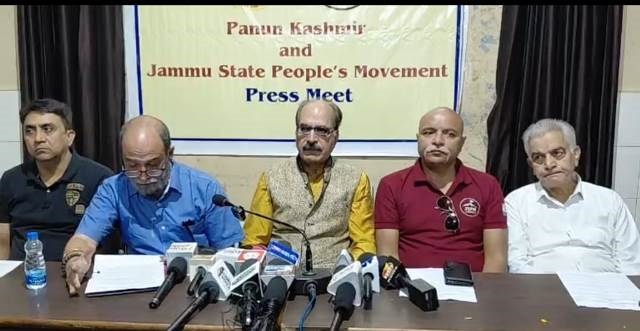
Jammu, October 27 (Scoop News)-Panun Kashmir has sought the personal intervention of the Prime Minister of India to protect the historical and religious character of Shankaracharya Parvat in Srinagar, expressing serious concern over reports that the Jammu and Kashmir Waqf Board may have sanctioned funds for the construction of a dargah on or in the vicinity of the ancient sacred hill.
The organisation has raised concerns over what it describes as a threat to the region’s ancient Hindu sacred heritage at Gopadri and has called for an inquiry into the reported funding.
In a memorandum addressed to the Prime Minister, with copies to the Union Home Minister and the Lieutenant Governor of Jammu and Kashmir, Panun Kashmir has demanded an immediate, time-bound inquiry into the reported sanction, disclosure of relevant financial and land records, and verification of all statutory permissions before any construction or alteration of the site is undertaken.
The memorandum has been submitted through Kuldeep Raina, General Secretary, Panun Kashmir, who emphasised that the issue concerns the protection of Kashmir’s ancient civilisational heritage and must be examined in accordance with historical evidence, constitutional principles and the rule of law.
Panun Kashmir has called upon the authorities to establish whether any financial approval, grant, tender or construction proposal has actually been sanctioned by the Waqf Board. It has sought disclosure of the amount involved, the precise location of the proposed construction, the legal status of the land and the permissions, if any, granted by the competent authorities. The organisation has maintained that the reported sanction must be verified through official records and that no irreversible alteration should be permitted until the facts and legal position are established.
Drawing attention to the antiquity of the sacred hill, Panun Kashmir has cited Kalhana’s Rājataraṅgiṇī, the twelfth-century chronicle of Kashmir, which refers to Gopadri and the shrine of Jyeṣṭheśvara in Book I, verse 341, in connection with King Gopāditya. The organisation maintains that this historical reference establishes the importance of the hill in Kashmir’s ancient Shaiva tradition and its wider religious and cultural history.
Situated above Dal Lake, Shankaracharya Parvat is associated with the ancient name Gopadri and the shrine of Jyeṣṭheśvara. The Shankaracharya Temple is recognised as a monument of national importance under the protection of the Archaeological Survey of India. Panun Kashmir has also highlighted the religious traditions associating Adi Shankaracharya with the hill, which occupies a significant place in the spiritual consciousness and civilisational memory of Kashmiri Pandits.
The organisation has asserted that Shankaracharya Parvat cannot be viewed merely as a geographical feature or an isolated monument. It represents a continuing link with Kashmir’s ancient philosophical, spiritual and cultural traditions. Any proposal capable of altering the religious character, historical setting or traditional identity of this sacred landscape, it has argued, must be subjected to rigorous legal and heritage scrutiny.
Raising the larger question of cultural genocide, Panun Kashmir has maintained that the erosion of a community’s civilisational identity cannot be measured solely by the physical destruction of its temples or monuments. It also raises concerns when the historical memory, sacred geography, cultural institutions and enduring connection of a displaced community with its ancestral homeland are weakened or compromised. In the context of the forced displacement of Kashmiri Pandits, the organisation considers the protection of Shankaracharya Parvat particularly significant, as the hill represents a living link to the Valley’s ancient Hindu civilisation. Panun Kashmir has cautioned that any unauthorised construction or alteration that compromises the established identity of this sacred landscape, if substantiated, could compound the community’s historical dispossession and deepen its sense of civilisational erasure. It has urged the government to examine the reported proposal not merely as a question of construction or land administration, but also in terms of its implications for cultural heritage, collective memory and civilisational continuity.
The organisation has expressed particular concern over the implications of any unexamined alteration of ancient Hindu sacred sites in the context of the displacement of Kashmiri Pandits from their ancestral homeland. It has maintained that the protection of surviving sacred places is inseparable from preserving the community’s historical memory, cultural continuity and connection with Kashmir.
The memorandum seeks an independent assessment by the Archaeological Survey of India and the competent heritage authorities to establish the precise location of any proposed construction and its relationship with the protected monument and its regulated surroundings. It also demands verification of the land’s ownership, revenue classification and any claim of Waqf status, supported by relevant documentary and statutory records.
Panun Kashmir has urged the government to issue appropriate preventive directions against any new construction, excavation or irreversible alteration at the disputed location until the facts have been verified and all legally required permissions examined. It has further sought consultation with representatives of the Kashmiri Pandit community, historians, heritage experts and other concerned institutions before any final decision affecting the site is taken.
The organisation has emphasised that its concerns are not directed against the religious rights of any community but arise from the imperative of protecting an ancient sacred site and ensuring equal respect for religious heritage. It has called for transparency in public administration and strict adherence to applicable heritage laws, including the Ancient Monuments and Archaeological Sites and Remains Act, 1958, wherever its provisions apply.
Through its General Secretary, Kuldeep Raina, Panun Kashmir has appealed to the Prime Minister to ensure that decisions affecting Shankaracharya Parvat are guided by historical documentation, transparent administrative procedures and the applicable legal framework. The organisation has also called for appropriate corrective and legal action if an official inquiry establishes any violation of heritage protections or other statutory requirements.
Panun Kashmir has urged the Government of India to provide a reasoned, time-bound response and establish a permanent mechanism for safeguarding ancient Hindu sacred sites in Kashmir, particularly those associated with the displaced Kashmiri Pandit community. It has maintained that protecting Shankaracharya Parvat in its historical and religious integrity is essential to preserving Kashmir’s civilisational inheritance and ensuring that the historical identity and cultural rights of Kashmiri Pandits receive due consideration.
... |
| |
|
|
Share this Story |
|
|
|
|
|
|
|
| |
|
|
| |
|
|