| News Details |
| Development must not come at the cost of the people and the pilgrims it is meant to serve.:Tarigami | | BRO clarification regarding use of heavy machinery at sheshnag does not mention any environmental clearance | 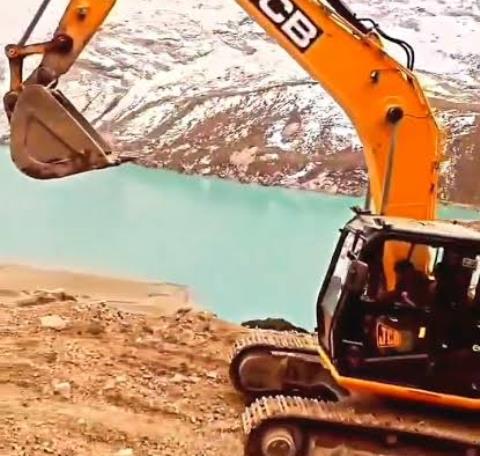
Srinagar, November 24 (Scoop News)- Sheshnag is not just another stretch of the Amarnath Yatra track. It is a glacial lake about 3,590 metres up in the Himalayas, set among steep slopes and glacial deposits, and it is the source of the East Lidder, which flows down to Pahalgam and the rest of Kashmir. Reports have listed Sheshnag among the 14 high-risk glacial lakes identified in Jammu and Kashmir. Crawler excavators have now been seen cutting and levelling earth beside this lake. Whatever the purpose of the work, heavy machinery should not be used on this ground until experts have examined it and said it can be done safely. Let there be no confusion about the Yatra. Many people across the country have deep faith in the Holy Cave and the Amarnath Yatra, and we respect it. Through every difficult period Kashmir has seen, people of every community have worked to keep the Yatra free of disruption. Our concern is that they arrive safely, stay safely and return home safely, and that the people who live in this belt stay safe too. Raising these questions is not interference with the Yatra, and it is not politics. The Border Roads Organisation says the work is confined to the existing tracks and that claims about new works are incorrect. It says the tracks are being widened to ease congestion and make passage safer, that environmental safeguards are being followed, and that it is protecting natural drainage and disposing of excavated material safely. If the work is only on the existing track, why are heavy
earthmovers needed? This work cannot be seen apart from the Khanabal–Baltal highway, NH-501. The project's design report, prepared by NHIDCL in January 2024, proposes 2- or 4-laning about 90 km of road from Khanabal to Baltal. It includes a new stretch from Chandanwari to Baltal along the
traditional Yatra route, through Pissu Top, Zojibal, Sheshnag and Panchtarni. The authorities must say clearly how the work under way relates to this alignment. The report was prepared before the cloudburst in Paddar in 2025 and the disaster in Nepal in 2026. What those two events showed about this kind of terrain must be taken into account before work on this scale goes ahead. The
Himalayas are young mountains, and they are still shifting. Cutting at the base of a slope removes its natural support and can set off landslides. Digging near a glacial lake can disturb the material around it, change the way water runs off, and push more sediments into the lake. Excavated rock and soil, if not disposed off properly, can block drainage and be carried downstream. Plants at this height grow for only a few months a year, so damaged ground takes years to recover. A motorable road also brings traffic, construction, waste and sewage to a place with limited capacity to absorb them. Roads, tunnels, pilgrim facilities and track widening along this route must be assessed together, not one
project at a time. The Supreme Court has already dealt with the Yatra route. After pilgrims died during the 2012 Yatra, the Court took up the matter on its own in Writ Petition (Civil) No. 284 of 2012. In its judgment of 13 December 2012, it accepted the recommendations of a Special High-Powered Committee on arrangements along the Yatra and set up a subcommittee to make sure they were followed. Any work on this route must respect those directions, and the public should be told how this work does. Parts of the route also pass through forest land. It must be made public whether forest clearance was sought, and whether the Forest Department was consulted and what it advised. We have seen what happens when the mountains are pushed too far. Last year, a cloudburst at Chasoti in Paddar, Kishtwar, struck the Machail Mata Yatra route. It killed 63 people, and two months later 31 were still missing. In August this year, a collapse of rock and ice in Nepal's Langtang sent a flood down the Bhote Koshi and Trishuli rivers. More than 1,400 people died in Nepal and dozens more in Tibet. Kedarnath in 2013 and South Lhonak Lake in Sikkim in 2023 are also on record. Nature has given us springs, lakes, forests and mountains. If we disturb them without care, we will pay for it in floods and landslides. We are not against roads or development. But the government must answer three questions in public. Has any independent expert body assessed whether the slopes around Sheshnag can take this excavation? Have environmental and forest clearances been sought or obtained? If so, why have they not been made public? And how does this work relate to the NH-501 alignment, which passes through Sheshnag? Where the excavated material is being dumped, and
who chose those sites, must also be made public. Until these answers are on record, the work near the lake must stop. The Government of India and the Government of Jammu and Kashmir should together set up an independent team of glaciologists, geologists, hydrologists, forest officials and disaster-management experts. It should visit Sheshnag, study the lake and its catchment, examine the work on the ground and make its findings public. The country has institutions that have studied
the Himalayas for decades, and their advice must be sought. If they find that the lake and the slopes will not be harmed, nobody will have any objection.
... |
| |
|
|
Share this Story |
|
|
|
|
|
|
|
| |
|
|
| |
|
|