| News Details |
| Sindh and the Partition of India: Historical Betrayal and Political Consequences | | 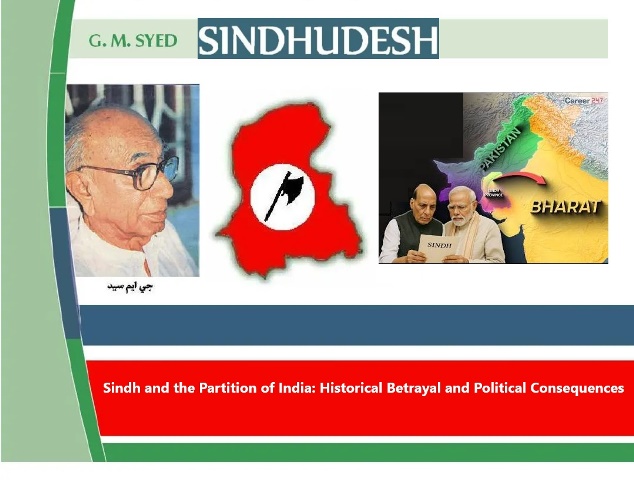
By Fatima Baloch
The Pakistani military has been facing a severe insurgency from the secular nationalist Balochistan Liberation Army (BLA) and the religious militant group Tehreek-e-Taliban Pakistan (TTP) in Balochistan and KPK, respectively. Similarly, Pakistan is facing growing resistance in POK (Pakistan-Occupied Kashmir). To conceal its defeats, the Punjabi-dominated military establishment is planning to create new provinces and further divide and disintegrate Sindh, a province that endorsed the British-designed so-called Two-Nation Theory and facilitated the creation of Pakistan in the name of religion during the partition of India. Today, Sindhis in Pakistan-occupied Sindh are protesting against the Pakistani military and chanting anti-Pakistan slogans in support of Sindhudesh. The situation is reminiscent of the 1970–71 Bangladesh crisis, particularly in Sindh, where the Pakistani military is highly likely to launch a military operation against Sindhi nationalism.
HISTORY OF SINDH WITH INDIA:
Historically and religiously Sindh has been a key part of India. Over time, Sindh was ruled by various empires, including Arabs, Mughals, and local dynasties, and later became part of British India in 1843. Historically, Sindh was part of undivided India and had a significant Hindu economic presence. Notably, Umerkot and Tharparkar districts are the primary areas in Sindh with the highest concentrations of Hindus. Mithi, the capital of Tharparkar, is particularly notable for having a very high percentage of Hindu population. While Hindu Sindhis reside throughout interior Sindh, they are especially concentrated in rural areas and small towns within these eastern desert districts. The word “Sindh” is also mentioned in the Indian national anthem. In 1936, Sindh was separated from the Bombay Presidency and became a distinct province under British rule, but it remained part of undivided British India until 1947. Before Partition, Sindh was an integral part of British India. It had a diverse population of Muslims, Hindus, Sikhs, and others who lived together peacefully in many areas, and they all considered themselves Sindhis first, regardless of their religion. The province was economically important because of its ports (particularly Karachi), agriculture, and trade networks. Cities like Karachi, Hyderabad, and Shikarpur were major commercial hubs, connected to the rest of India and international trade routes.
Pakistan was created by the British in the name of Islam, but Pakistan has little to do with Muslims or Islam. Instead, it has consistently served British and U.S. strategic interests against Muslims. With British support, the Muslim League was established in Dhaka in 1905 in opposition to the Indian National Congress (INC). The British encouraged Hindu–Muslim riots to sustain their colonial policy of “divide and rule” and to advance their scheme of creating Pakistan in the name of religion. During the Partition of India in 1947, British India was divided into India and Pakistan on religious grounds, and Sindh became part of Pakistan. Since then, not only Sindhi-speaking Muslims but also Hindus have suffered. One Sindhi man considered responsible, from this viewpoint, for this plight is Ghulam Murtaza Syed (G.M. Syed).
Ghulam Murtaza Syed (G.M. Syed) was born in Sann, Jamshoro District, Sindh, British India, on 17 January 1907. He was a prominent Sindhi Muslim politician, scholar, and the founder of the Jeay Sindh Movement (JSM). During his political career, he joined the All-India Muslim League in 1938, rose rapidly, and became President of the Sindh Muslim League in 1943. He was also a close political ally of Muhammad Ali Jinnah. He played a significant role in the creation of Pakistan by supporting the Two-Nation Theory and helping to pass the Pakistan Resolution in the Sindh Assembly in 1943. His political stance aligned with the British policy of dividing the Indian subcontinent, which led to the Partition of India in 1947 on religious grounds. This division ultimately resulted in large-scale suffering, particularly for Muslims who remained in India, as well as for Muslims in Pakistan, since Pakistan has never fully developed into a democratic and welfare-oriented state.
Before the creation of Pakistan, Hindus in Sindh were also true Sindhis and sons of the soil—an integral part of Sindhi society—sharing the same language, culture, and regional identity. However, during his association with the Muslim League, G.M. Syed strongly opposed Sindhi Hindus, denying them the status of true sons of the soil. This opposition stemmed from his insecurity towards economically prosperous Sindhi Hindus, many of whom were businessmen and industrialists, and he may have feared their growing influence and progress . In 1943, he made comparisons between Hindus in Sindh and Jews in Germany and advocated their expulsion after the creation of Pakistan. Overall, he was a key Muslim League leader who supported the partition of a unified India and the creation of Pakistan.
Following the separation of East Pakistan and the creation of Bangladesh in 1971, and realizing that the Two-Nation Theory had been dusted, G.M. Syed founded the JSM in 1972 and initiated a movement for Sindhudesh. However, unlike the armed struggle seen in Bangladesh or the resistance led by Khair Bakhsh Marri in Balochistan in 1972—which continues today in the form of a strong nationalist armed struggle rooted in Baloch society—G.M. Syed did not mobilize an armed movement. Instead, he pursued a political, democratic, and non-violent approach for a free and independent Sindhudesh. This raises questions about the effectiveness of non-violent struggle in a state like Pakistan, which has used severe force in conflicts such as those leading to Bangladesh’s independence. Non-violent, democratic struggles for independence may only succeed when waged against a civilized democratic nation or federation. In the context of Pakistan, non-violent movements may not achieve their intended goals.
However, although G.M. Syed later provided a political vision for Sindhudesh, it came too late. This vision does not outweigh his earlier political mistakes, particularly his strong support for the creation of Pakistan based on religious ideology and his role in bringing the Sindhi nation into Pakistan. Today, Pakistan is neither fully an Islamic nor a democratic republic. Sindh has been suffering from state brutality, poverty, corruption in education, agriculture, industry, road development, and other sectors. this is a consequence of his poor vision and political blunders.
Some people argue that G.M. Syed spent 33 years in prison for Sindhudesh as evidence of his commitment. However, it is important to note that this period includes his detention during British rule as well as later imprisonment. Specifically, his imprisonment related to the Sindhudesh movement lasted from 6 May 1973 to 2 July 1987—approximately 14 years. Due to selfishness, narrow thinking, and short-term political interests, his ideological goal of an independent Sindhudesh ultimately failed. In the final years of his life he regretted his political decisions regarding the creation of Pakistan. According to political experts and social economists, Sindh might have achieved better development had it remained within a united India, like Gujarat and Maharashtra. Alternatively, if G.M. Syed had called upon Sindhis in 1973 to launch an armed struggle, similar to the one in Bangladesh, neighbouring India might have supported the Sindhudesh movement in a similar manner.
G.M. Syed, who supported the disintegration of India, contributed to tearing apart Sindh's social fabric in the name of religion by supporting the mass exodus of Sindhi-speaking Hindus. He effectively brought the Sindhi nation into Pakistan, and since then, the Sindhi people have faced oppression and mass killings. Today, Sindh is facing an existential threat from Pakistan. Therefore, he is a Sindh traitor rather than celebrated as a great leader. Great leaders are neither narrow-minded nor short-sighted.
G.M. Syed passed away on 25 April 1995. He is often described as having adopted a Sufi-oriented and secular vision later in life, advocating for a moderate Sindhudesh. However, this later transformation contrasts sharply with his earlier political stance, which strongly supported the creation of Pakistan on religious grounds. He is viewed by some as having contributed to the subjugation of Sindhis within what they consider an unnatural state like Pakistan and as being partly responsible for their suffering.
In reality, Pakistan has damaged Islam by producing desperation, helplessness, and instability. This division fractured the Indian subcontinent and weakened Muslim political cohesion. It is deeply unfortunate that Muslim scholars today rarely reflect on how the partition of the subcontinent and the creation of Pakistan affected the broader Muslim community. Before Partition in 1947, Muslims formed a significant minority in British India—around 100 million people, approximately 25% of the population. After Pakistan’s creation, the Muslim population in India declined from 42.4 million (12.3%) in 1941 to 35.4 million (9.8%) in the 1951 census due to partition-related upheaval.
As of 2026, Muslims in India constitute approximately 18%–20% of the population. Had Partition not occurred, a united India would today host the world’s largest Muslim population—potentially exceeding 600 million when including Muslims from present-day India, Pakistan, and Bangladesh. This would represent a substantial minority (35%–45%) within a diverse nation of over 1.6 billion people, alongside Sikhs, Christians, and historically oppressed Hindu communities such as Dalits. In such a scenario, economic integration, shared urban life, and inter-community cooperation would likely have reduced communal hatred permanently.
Many Muslim scholars and prominent INC Muslim leaders, including Maulana Abul Kalam Azad, opposed the Partition of India and the creation of Pakistan. In April 1946, in an interview with Agha Shorish Kashmiri, editor of the Lahore-based Urdu magazine Chattan, Azad predicted that the Pakistan scheme would weaken Muslims and would not serve Islam. He warned that when Muslims in Pakistan were mistreated by wealthy industrialists, corrupt politicians, and the military, Indian Muslims would be unable to help them. Similarly, Indian Muslims—reduced to a minority—would not receive support from Pakistan. However, he believed that Indian Muslims’ rights would be secured under a secular Indian republic governed by constitutional law, and that over time they would recover as both true Muslims and true Indians, while Indian Muslims migrating to Pakistan would not be accepted by Sindhis, Pashtuns, and others, would lose their identity, and would remain Muhajirs and oppressed. He further predicted that Pakistan would eventually fragment into several parts.
Former Deputy Prime Minister of India, L.K. Advani Sindhi, has historically expressed sadness that Sindh, his birthplace, became part of Pakistan, stating in 2017 that India feels “incomplete” without it. Born in Karachi in 1927, Advani frequently lamented the 1947 separation of the region, emphasizing its deep cultural and historical ties to India. It is also to be noted that Indian Defence Minister Rajnath Singh stated in November 2025 that Sindh, a province in Pakistan, could one day return to India, emphasizing its place in India’s “civilisational heritage” and noting that “borders can change.” Earlier, in October 2025, he stated that the “road to Karachi passes through Sir Creek,” indicating that any aggression in that Gujarat border sector and Pakistan military operations in Sindh could result in a severe Indian military response. These remarks, viewed as part of a stronger stance on India’s borders and cultural ties, were dismissed as “delusional” by Pakistan.
On October 8, 2023, Uttar Pradesh Chief Minister Yogi Adityanath stated at a National Sindhi Convention in Lucknow that if the Ram Janmabhoomi site in Ayodhya could be reclaimed after 500 years, there was no reason why India could not take back "Sindhu" (the Sindh province in Pakistan). Adityanath also said that the Sindhi community had suffered greatly following the 1947 Partition and urged them to share their history with younger generations. At the International Sindhi Conference held on December 16, 2011, in Ahmedabad, Modi highlighted the historical ties between Sindh and Gujarat and called upon the global Sindhi community to protect its heritage. Additionally, on February 26, 2026, Western Army Commander Lt. Gen. Manoj Kumar Katiyar stated that future victory would be achieved on the ground, signalling a shift towards more decisive, direct, and territorial action while issuing a strong warning to Pakistan.
India has a professional army and knows that war is never a desirable option; however, history demonstrates that nations are sometimes compelled to resort to military action in the pursuit of peace, sovereignty, and national security. India’s experiences in 1965 and 1971 underscore this reality. Whenever issues of territorial integrity, national dignity, and security have been compromised, India has demonstrated a willingness to bear significant sacrifices in defense of its national interests and honour. These conflicts, though costly, ultimately reshaped the regional order and contributed to long-term strategic stability.
Conclusion:
Based on all this, it is concluded that India may retaliate to capture some parts of Sindh in response to any Pakistan military operation in Sindh in process of dividing Sindh and Pakistan-sponsored terrorist attack. Additionally, in the context of chaos in POK, TTP, BLA, and current Pakistan military tensions with Afghanistan, Indian strategists must recognize that the Pakistan Army could collapse under pressure from the TTP and BLA, much like the former Afghan National Army did before the Taliban’s capture of Kabul on August 15, 2021. In such a scenario, PoK could fall under TTP influence. A destabilized Pakistan dominated by extremist forces would threaten South Asian stability and India’s security, while an independent, secular Balochistan and Sindhu desh could serve as a stabilizing regional partner. The disintegration of Pakistan and the establishment of a secular Baloch republic and Sindh would neutralize CPEC routes through PoK, weaken China–Turkey and other anti-India alignments, and allow Afghanistan to reclaim territories across the Durand Line, potentially reshaping the Greater Afghanistan project.
About the Author
Fatima Baloch is a senior geopolitical and regional affairs analyst who writes extensively on Afghanistan, Balochistan, and India, with a focus on regional security dynamics, insurgency movements, and South Asian strategic affairs.
(Disclaimer: The views, observations and opinions expressed in above write up of Scoop News are strictly author's own. Scoop News does not take any onus or liability for the veracity, accuracy, validity, completeness, suitability of any of information in the above given write up. The information, facts or figures appearing in the write up in no way manifest the position, standpoint or stance of Scoop News and the Scoop News does not assume any encumbrance or answerability of the same. All disputes are subject to the exclusive jurisdiction of competent Courts and Forums in Jammu City Only)
Editor
Scoop News,(scoopnews.in)
... |
| |
|
|
Share this Story |
|
|
|
|
|
|
|
| |
|
|
| |
|
|